NEWS
Hot-rolled carbon steel and cold-rolled carbon steel are essentially the same, but due to the huge differences in their production processes, they have fundamental differences in performance, appearance and application.
Hot-rolled steel is like "coarse grain," offering high strength and affordability, but also a rough appearance.
Cold-rolled steel is like "fine grain," offering a smooth surface, precise dimensions, and greater strength and hardness. However, it also comes at a higher price.
There are significant differences between hot-rolled carbon steel and cold-rolled carbon steel in production process, performance characteristics, surface quality, etc., as follows:
1. Production Process:
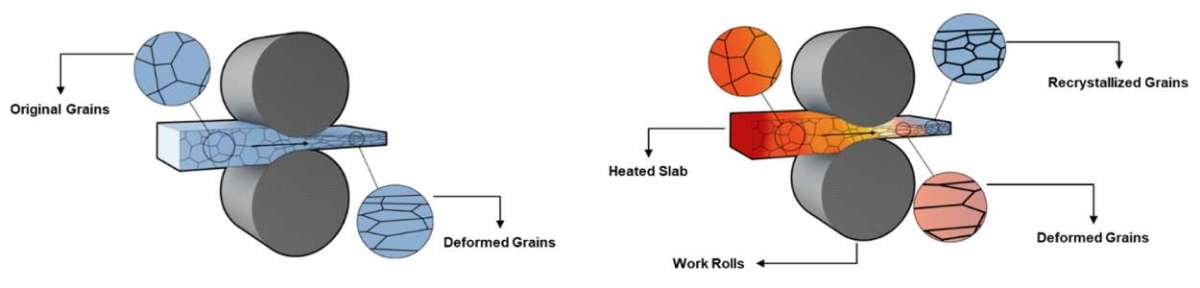
Hot-rolled carbon steel is produced by heating a steel slab to approximately 1000°C-1250°C, then roughing and finishing the steel at high temperatures to form a finished product.
Cold-rolled carbon steel is produced from hot-rolled coils, which are first pickled to remove scale and then subjected to multiple rolling passes at room temperature. Annealing is typically also required to eliminate cold work hardening.
2. Processing Temperature:
Hot-rolled carbon steel is rolled at a temperature above the recrystallization temperature of the steel, generally above 1000°C.
Cold-rolled carbon steel is rolled at room temperature, below the recrystallization temperature of the metal, without heating.
3. Performance Characteristics:
Hot-rolled carbon steel has a relatively coarse but evenly distributed grain structure, allowing for partial release of residual stresses. This results in excellent toughness and the ability to withstand significant impact forces.
Cold-rolled carbon steel undergoes significant grain refinement through cold work hardening, resulting in higher strength and hardness, improved surface finish, and dimensional accuracy. However, its toughness is relatively poor, making it unsuitable for applications subject to severe impact.
4. Surface Quality:
During the hot rolling process, scale easily forms on the surface of the hot steel billet. Despite descaling, fine marks may remain on the surface, resulting in a less than smooth surface.
Cold-rolled carbon steel is rolled at low temperatures throughout the entire process, eliminating scale and achieving a highly smooth surface finish that can achieve a near-mirror finish.
5. Dimensional Accuracy:
Hot rolling uses high-speed, high-reduction rolling to maintain dimensional accuracy to the centimeter level;
Cold rolling uses multiple, small-reduction rolling passes to achieve dimensional accuracy down to the millimeter level, meeting the demands of precision manufacturing.
6. Applications:
Hot-rolled carbon steel is commonly used in applications such as building structures and large machinery components, where mechanical properties are high but surface quality and dimensional accuracy are relatively low, such as bridges and automobile beams.
Cold-rolled carbon steel is primarily used in applications requiring high flatness, smoothness, and dimensional accuracy, such as home appliance panels, automobile housings, and precision instrument parts.
7. Production Cost:
Hot-rolled carbon steel requires high initial energy investment, but high rolling efficiency and low equipment maintenance costs, resulting in relatively low overall production costs.
Cold-rolled carbon steel has a lengthy production process, requires high equipment precision, and requires annealing and other treatments, resulting in higher production costs.
The choice of hot-rolled or cold-rolled steel depends entirely on your application requirements:
If high strength, low cost, and appearance is unimportant (such as in internal structures or where painting is required), choose hot-rolled steel.
If a refined appearance, precise dimensions, and increased strength are required, and if fine finishing such as electroplating or painting is desired, choose cold-rolled steel.

By clicking 'Allow All', you agree to the storage of cookies on your device to enhance site navigation, analyze site usage and assist with our marketing efforts. Coo Cookie Notice